• Skip to primary navigation
  • Skip to main content
  • Skip to primary sidebar
  • Skip to footer

Sealing & Contamination Control Tips

Fluid Power Sealing and Contamination Control Information and Resources

  • News
  • Contamination Control
  • Filtration
  • Seals
  • Fluids
  • Design Guides
  • Advertise
  • Subscribe
You are here: Home / Seals / Hallite, MSOE partner for continued hydraulic seal testing

Hallite, MSOE partner for continued hydraulic seal testing

March 28, 2018 By Mary Gannon Leave a Comment

Share

Cold cylinder start-up hydraulic seal testing is the latest in Hallite’s third-party validation for the integrity of its sealing materials and designs.

After successful completion of a new test method in 2015 for assessing the amount of dirt and dust that enters a typical hydraulic system through the rod wiper, Hallite Seals decided to continue its partnership with the Milwaukee School of Engineering (MSOE) Fluid Power Institute for several more rounds of hydraulic seal testing.
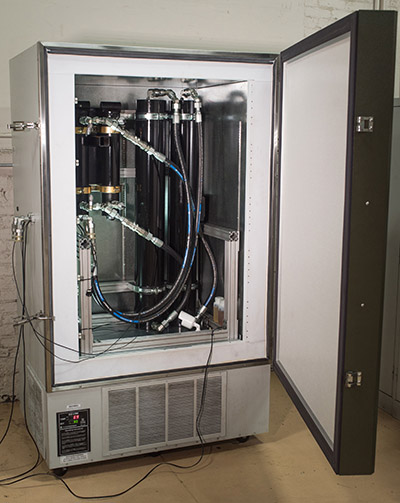
Hallite-cold-start-test-chamber
The cold-start test chamber developed by Hallite and MSOE to test the effect of cold starting temperatures on hydraulic rod seals.

Since the development of the rod wiper test, Hallite and MSOE have worked together to develop additional repeatable, comparative tests that allow Hallite to understand performance of existing and new prototype products. “MSOE does a lot of hand-in-hand work with Hallite,” said Russ Steinmmetz, MSOE Project Engineer.

Tests conducted to date include five specific areas:

1. insertion and break-away force testing for piston seals
2. frictional drag testing for rod seals at different pressures
3. deflection and compression testing for wear bands
4. cold cylinder start-up testing for rod seals
5. endurance testing for rod seals featuring a first-of-its-kind test chamber where 16 rod seals can be tested simultaneously

The partners have recently concluded the first step in the cold cylinder start-up testing for rod seals’ performance, said Chuck White, Director of Commercial Development for Hallite. This test is different from standard cold-start tests, he explained, because most current tests may have the cylinder in a freezer but the oil may be warm at the start. Instead, the MSOE and Hallite test begins with the sub-Arctic temperatures one may find in Northern Canada, for example. The procedure requires cold soak of cylinders for 8-12 hours prior to cycling and the extremely low temperatures in the freezer effectively replicate conditions as if the machine was outside overnight. “Most of the current test standards do not replicate real-life cold-start conditions.”
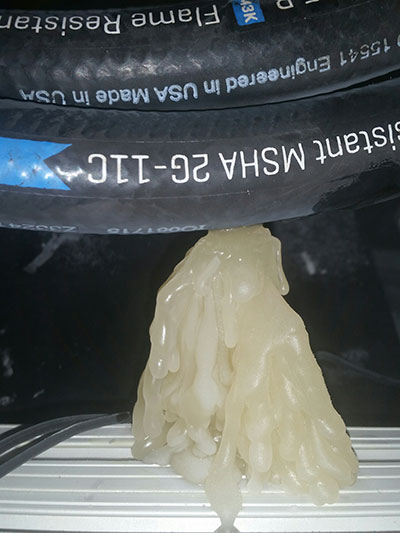
Hallite-cold-start-test-chamber-fluid-leak
The cold-start test chamber shows what happens to seals in Arctic conditions, when they fail, causing fluid leaks.

MSOE developed a closed-loop/circuit system using accumulators to keep cold and warm oil separated in the application and to ensure consistent readings from test to test. This repeatable test chamber can reach –110°F (–80°C).

Hallite saw a need for this test when several cylinder customers came to its engineers with cold-start issues. So Hallite decided to use various cylinders available in the market with its rod seals to conduct side-by-side comparisons with different competitive profiles.

Cylinder pressure is just enough to move the rod, and cylinder speed is as slow as possible—down to ½ in/sec—to simulate worst conditions. As White said, these are “the worst possible operating conditions for a rod seal in cold conditions.” When we start a cycle, if the temperature jumps more than 5°, we stop the test and let the oil cool down to the target test temperature.” Due to the oil viscosity being that of jelly at very low temperatures, ports in the hydraulic cylinder were adjusted to 1 inch in diameter to maximize the flow path of the stiff fluid.

Hallite’s rod seals are rated for -50°F in the catalog, which is considered Artic conditions. The test is performed down to a maximum–65°F, as this becomes the limit for typical Arctic ISO 15 oils to remain fluid enough for a hydraulic system to operate.

White said that Hallite’s rod seals have performed quite well in the tests. They have installed a camera in the freezer, which allows them to see how the seals perform under these harsh conditions. “With the camera, we can monitor the leakage during the test cycle” White said. “So in real time, we can see what’s going on in there.”

See the test chamber in action in this video below:

Leakage is assessed by seeing oil build up on the rods. Using a visual leakage standard which employs a scale of 0 to 5—which has been adopted by many OEM hydraulic manufacturers —0 means there is no leakage, 0-2 is where you want to be performing as this there is no presence of oil dripping from the rod, at 3 there is a presence of intermittent fluid and non-falling beaded oil formation, and 4-5 is clearly a failure. It’s unacceptable to be in that range, said White.

“For Hallite’s 605 asymmetrical U-cup, in tests to –65°F, we saw no leakage , so we’re at a 0. Hallite 621 saw a leakage rate of 1 at temperatures down to –65F,” White said. “This indicates how both the seal profile and material will perform. If it falls within the acceptable range, this is what is to be expected in the field. This kind of testing is something that I don’t see our competitors doing.”
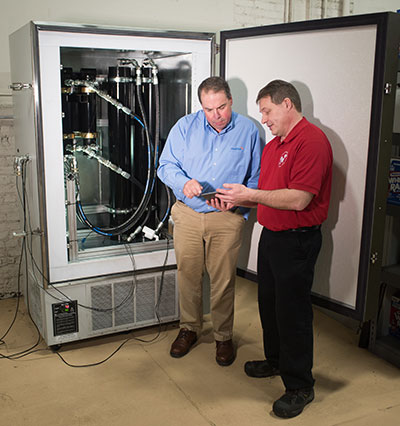
Hallite-Chuck-White-+-MSOE-Russ-Steinmmetz-cold-start-test-chamber
Hallite’s Chuck White and MSOE’s Russ Steinmmetz review results from their cold start test chamber.

Hallite is in the process of testing several different rod seal profiles and materials to better understand how their products react in extremely cold conditions. “This allows us to be able look at what the true capabilities of our materials and profiles really are,” White said. “This will also allow us to develop new materials and profiles, so we’re always ready to meet the market’s needs keeping in mind how these new products react in cold temperature conditions.

This is just the first phase in this particular test. MSOE and Hallite plan to test with other types of Arctic fluids to understand how they perform in cold conditions with the seals. Hallite and MSOE will also be utilizing the fluid test facilities located in the Chase Commerce Center in Milwaukee. Featuring major hydraulic power capabilities, MSOE has specialized equipment for evaluating pumps, valves, motors, cylinders, tubes, filters, and winches in accordance with appropriate NFPA, ANSI, SAE, ISO and MIL standards.

According to Tim Kerrigan, director of the Fluid Power Institute, “Student involvement is a big part of what we provide in these highly repeatable tests. They work very hard to design tests that can do that.”

White added, “MSOE is great at developing test processes that repeatable. For us to have third-party results, especially from MSOE which is so well-known in the industry, that’s powerful.”

Hallite
hallite.com/us/

MSOE
www.msoe.edu

You may also like:

  • Hallite-2-excavator
    Hydraulic seals battle extreme cold

  • Where are rod seals used?
  • Hallite-PTFE
    Day 2 IFPE: Innovations in hydraulic sealing technologies

  • Hallite announces comparative test report for the Armorlene HLX Bronze-Filled…
  • hallite-armorlene-ptfe-catalog-2016-128
    Hallite Announces availability of Armorlene PTFE products and materials

Filed Under: Blogs, News, Seals Tagged With: hallite, msoe

Reader Interactions

Leave a Reply Cancel reply

Your email address will not be published. Required fields are marked *

This site uses Akismet to reduce spam. Learn how your comment data is processed.

Primary Sidebar

Fluid Power World Digital Editions

Fluid Power World Digital Edition

Browse the most current issue of Fluid Power World and back issues in an easy to use high quality format. Bookmark, share and interact with the leading design engineering magazine today.

Fluid Power Design Guides

fluid
“sact
EXPAND YOUR KNOWLEDGE AND STAY CONNECTED
Get the latest info on technologies, tools and strategies for Fluid Power Professionals.

Meta

  • Log in
  • Entries feed
  • Comments feed
  • WordPress.org

Archives

  • April 2026
  • March 2026
  • February 2026
  • January 2026
  • November 2025
  • October 2025
  • September 2025
  • August 2025
  • July 2025
  • June 2025
  • May 2025
  • April 2025
  • March 2025
  • February 2025
  • January 2025
  • December 2024
  • November 2024
  • October 2024
  • September 2024
  • August 2024
  • July 2024
  • June 2024
  • May 2024
  • April 2024
  • March 2024
  • February 2024
  • January 2024
  • December 2023
  • November 2023
  • October 2023
  • September 2023
  • August 2023
  • July 2023
  • June 2023
  • May 2023
  • April 2023
  • March 2023
  • February 2023
  • January 2023
  • December 2022
  • November 2022
  • October 2022
  • September 2022
  • August 2022
  • July 2022
  • June 2022
  • May 2022
  • April 2022
  • March 2022
  • February 2022
  • January 2022
  • December 2021
  • November 2021
  • October 2021
  • September 2021
  • August 2021
  • July 2021
  • June 2021
  • May 2021
  • April 2021
  • March 2021
  • February 2021
  • January 2021
  • December 2020
  • November 2020
  • October 2020
  • September 2020
  • August 2020
  • July 2020
  • June 2020
  • May 2020
  • April 2020
  • March 2020
  • February 2020
  • January 2020
  • December 2019
  • November 2019
  • October 2019
  • September 2019
  • August 2019
  • July 2019
  • June 2019
  • May 2019
  • April 2019
  • March 2019
  • February 2019
  • January 2019
  • December 2018
  • November 2018
  • October 2018
  • September 2018
  • August 2018
  • July 2018
  • June 2018
  • May 2018
  • April 2018
  • March 2018
  • February 2018
  • January 2018
  • December 2017
  • November 2017
  • October 2017
  • September 2017
  • August 2017
  • July 2017
  • June 2017
  • May 2017
  • April 2017
  • March 2017
  • February 2017
  • January 2017
  • December 2016
  • November 2016
  • October 2016
  • September 2016
  • August 2016
  • July 2016
  • June 2016
  • May 2016
  • April 2016
  • March 2016
  • February 2016
  • January 2016
  • December 2015
  • November 2015
  • September 2015
  • August 2015
  • July 2015
  • June 2015

Recent Comments

    Categories

    • Blogs
    • Contamination Control
    • Featured
    • Filtration
    • Fluids
    • Mobile Hydraulic Tips
    • News
    • Products
    • Seals
    • tanks and reservois
    • Testing Equipment
    • Uncategorized

    Recent Comments

      Archives

      • April 2026
      • March 2026
      • February 2026
      • January 2026
      • November 2025
      • October 2025
      • September 2025
      • August 2025
      • July 2025
      • June 2025
      • May 2025
      • April 2025
      • March 2025
      • February 2025
      • January 2025
      • December 2024
      • November 2024
      • October 2024
      • September 2024
      • August 2024
      • July 2024
      • June 2024
      • May 2024
      • April 2024
      • March 2024
      • February 2024
      • January 2024
      • December 2023
      • November 2023
      • October 2023
      • September 2023
      • August 2023
      • July 2023
      • June 2023
      • May 2023
      • April 2023
      • March 2023
      • February 2023
      • January 2023
      • December 2022
      • November 2022
      • October 2022
      • September 2022
      • August 2022
      • July 2022
      • June 2022
      • May 2022
      • April 2022
      • March 2022
      • February 2022
      • January 2022
      • December 2021
      • November 2021
      • October 2021
      • September 2021
      • August 2021
      • July 2021
      • June 2021
      • May 2021
      • April 2021
      • March 2021
      • February 2021
      • January 2021
      • December 2020
      • November 2020
      • October 2020
      • September 2020
      • August 2020
      • July 2020
      • June 2020
      • May 2020
      • April 2020
      • March 2020
      • February 2020
      • January 2020
      • December 2019
      • November 2019
      • October 2019
      • September 2019
      • August 2019
      • July 2019
      • June 2019
      • May 2019
      • April 2019
      • March 2019
      • February 2019
      • January 2019
      • December 2018
      • November 2018
      • October 2018
      • September 2018
      • August 2018
      • July 2018
      • June 2018
      • May 2018
      • April 2018
      • March 2018
      • February 2018
      • January 2018
      • December 2017
      • November 2017
      • October 2017
      • September 2017
      • August 2017
      • July 2017
      • June 2017
      • May 2017
      • April 2017
      • March 2017
      • February 2017
      • January 2017
      • December 2016
      • November 2016
      • October 2016
      • September 2016
      • August 2016
      • July 2016
      • June 2016
      • May 2016
      • April 2016
      • March 2016
      • February 2016
      • January 2016
      • December 2015
      • November 2015
      • September 2015
      • August 2015
      • July 2015
      • June 2015

      Categories

      • Blogs
      • Contamination Control
      • Featured
      • Filtration
      • Fluids
      • Mobile Hydraulic Tips
      • News
      • Products
      • Seals
      • tanks and reservois
      • Testing Equipment
      • Uncategorized

      Meta

      • Log in
      • Entries feed
      • Comments feed
      • WordPress.org

      Footer

      Sealing and Contamination Tips

      Fluid Power World Digital Network

      • Fluid Power World
      • Mobile Hydraulic Tips
      • Pneumatic Tips
      • Hose Assembly Tips
      • Leadership in Engineering

      Sealing & Contamination Control

      • Subscribe to Fluid Power World
      • Videos
      • Advertise with us
      • About us

      Copyright © 2026 · WTWH Media, LLC · Privacy Policy