• Skip to primary navigation
  • Skip to main content
  • Skip to primary sidebar
  • Skip to footer

Sealing & Contamination Control Tips

Fluid Power Sealing and Contamination Control Information and Resources

  • News
  • Contamination Control
  • Filtration
  • Seals
  • Fluids
  • Design Guides
  • Advertise
  • Subscribe
You are here: Home / Featured / Eco-friendly shipping is possible with EALs

Eco-friendly shipping is possible with EALs

October 26, 2023 By Mary Gannon Leave a Comment

Share

The global shipping and marine industry is, like all industries, pursuing new ways to become more environmentally friendly. The use of environmentally acceptable lubricants (EALs) can make a major impact in that push.

By Joshua Dickstein, Ph.D., Technology Development Manager, The Lubrizol Corporation

Industries around the world are making sustained efforts to better protect the environment. That includes the global shipping and marine industry, which today is responsible for an estimated 3% of worldwide greenhouse gases.

LEAD-OPTION-marine-environments-3

The International Maritime Organization (IMO) recently set an aggressive target to reduce the carbon intensity of international shipping by at least 40% by 2030 and will seek to achieve a reduction of at least 50% by 2050, compared to levels in 2008. As these goals are pursued, it’s anticipated that alternative fuels will steadily rise in adoption. Biofuels will be attractive because they can be used as a drop-in option — meaning they can help reduce carbon dioxide emissions with limited hardware investment needed for operators. Methanol, liquid natural gas and ammonia — new frontiers for marine applications — are expected to make gains, too.

Meanwhile, other measures are set to impact all fluids found throughout major cargo ships. The U.S. Environmental Protection Agency’s (EPA’s) Vessel General Permit (VGP) will soon be replaced with the Vessel Incidental Discharge Act (VIDA), which establishes a framework for the regulation of discharges incidental to the normal operation of a vessel under a new Clean Water Act.

Regarding these measures, it’s notable that significant volumes of fluids found on ships — hydraulic fluids, gear oils, greases, and other lubricants — leak into waterways via seepage, spillages and careless disposal every year. Minimizing the impact of such losses has become increasingly critical, and it can be done through the greater proliferation of EALs. Marine original equipment manufacturers and industrial fluid formulators have the opportunity to develop and utilize such fluids in order to maximize environmental protection — read on to find out how.

What Are EALs?
As defined by the EPA, EALs have demonstrated acceptable levels of biodegradability, minimal aquatic toxicity and non-bioaccumulative potential.

  • Biodegradability: The capacity of lubricants to be decomposed by microorganisms over time into:
  • A combination of simpler by-products (primary biodegradation)
  • Carbon dioxide and water (ultimate biodegradation)
  • Minimal Aquatic Toxicity: Low toxicity to aquatic organisms according to tests defined by the Organization for Economic Cooperation and Development (OECD) and EPA test guidelines.
  • Non-bioaccumulative potential: Low probability of chemical buildup within the tissues of an organism over time.
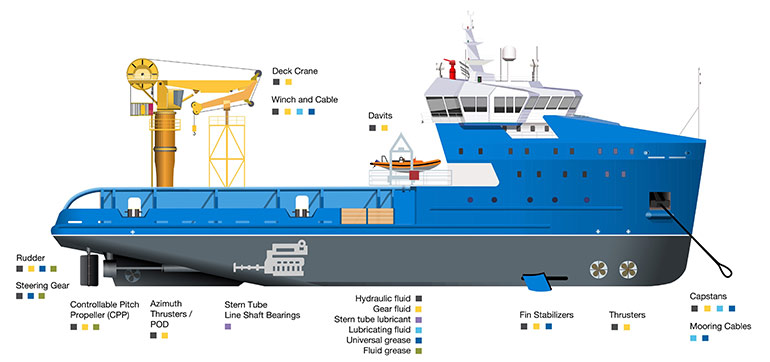
Shipping vessels have numerous operations requiring industrial lubricants. This graphic highlights the many functions and lubricants used in each.Image Lubrizol Corp.
Shipping vessels have numerous operations requiring industrial lubricants. This graphic highlights the many functions and lubricants used in each. Image courtesy of Lubrizol Corp.

Marine application opportunities for EALs
Major cargo ships are vast and complex, and are home to dozens of applications where EALs can help improve environmental impact. Hydraulic fluids, gear oils, stern tube lubricants, lubricating fluids, and greases can be found throughout a broad range of important equipment, including:

  • Ship engines, responsible for powering the ship across vast distances.
  • Steering and propulsion equipment, including rudders, controllable pitch propellers, stern tubes, fin stabilizers, thrusters, and more.
  • Operational equipment, including deck cranes and winches and cables for maneuvering cargo pods from place to place, along with davits, responsible for lowering and retrieving dinghies and other smaller vessels.

Each of these points represents an opportunity for the fluid to escape into the environment, whether via user error, machine damage, or other events. What’s more, many of them are below the waterline — leakages would necessarily infiltrate the oceans. Given the scale of these ships and the sheer volume of fluids required to keep them operational, loss of such fluids can make a major impact on oceanic and marine life — and minimizing the harm resulting from such losses is increasingly important.

Maintaining elevated performance  in EAL formulations
OEMs and fluid formulators, however, do face some challenges when it comes to developing EALs that reliably deliver the kinds of performance required in critical marine applications. For example, a top consideration for any industrial fluid is the protection of equipment. Preventing the premature wear of metal surfaces as they come into contact with each other is a core function of a lubricant — EAL or not.

To ensure EALs maintain such performance, specific formulation considerations must be made. For example, one of the most popular reliable classes of anti-wear additives used in conventional fluids and lubricants are zinc dialkyl dithiophosphates (ZDDPs). But because ZDDPs do not naturally biodegrade as necessitated by EAL classifications, formulators cannot use them when developing EAL products. A different type of environmentally acceptable anti-wear additive chemistry must be selected.

This hurdle holds true for several other critical performance requirements marine fluids must demonstrate. An industrial gear oil used in a ship’s deck crane, for instance, typically incorporates extreme pressure additives. Sulfurized olefins are another reliable solution for these needs, but like ZDDPs, do not display the biodegradability required in accordance with EAL standards. In fact, many conventional chemistries frequently used such as demulsifiers, antifoam agents, corrosion inhibitors, friction modifiers, and viscosity modifiers cannot be used in the composition of an EAL.

EAL standards further restrict the use of traditional mineral oils due to biodegradability and toxicity concerns. Therefore, synthetic base oil formulations from Groups IV (polyalphaolefins) and V (for example, esters) are required for EALs in place of Groups I, II and III base oils.

Opportunity for marine lubricant marketers
Despite the formulation challenges described above, high-performance additives compliant with EAL guidelines are available, and they can be taken advantage of to deliver more environmentally friendly finished fluids to the marine market. And as environmental protection initiatives continue, it is worth the investment to capture growing EAL markets.

Research from the consulting and market research firm Kline & Company anticipates that marine EALs will see significant growth potential in the coming years, along with applications in agriculture, construction, mining, and offshore power generation. These applications have high potential for lubricating fluids to impact the surrounding environment via leakage or mishandling. Demand is expected to be greatest in North America and Europe in the coming years as legislative measures continue to grow more stringent. Hydraulic fluids — including those found in rudders, steering gear, fin stabilizers, thrusters, and more — are expected to be the dominant application for EAL demand, with other applications making up the rest.

To capitalize on these needs, working collaboratively with the right partner can be beneficial to develop environmentally certified and performance-validated fluids. A true partner should be able to offer reliable chemical expertise and EAL-compatible solutions, enabling lubricant marketers to expand EAL marine offerings quickly. To those ends, Lubrizol is committed to helping industrial fluids manufacturers find success with new EAL solutions.

Demand for EALs only stands to grow in a marine industry that is increasingly concerned with reducing its environmental impact while continuing to reliably serve global markets. For fluid marketers, it is worth investigating EAL solutions that are able to meet environmental standards while maintaining robust performance that the global supply chain depends upon.


Lubrizol
Lubrizol.com

You may also like:

  • Hydro-Safe-Select-VG-32
    Environmentally friendly Hydro-Safe premium hydraulic fluid for sustainable designs
  • environmentally acceptable lubricants EALs shutterstock-hydraulic-fluid
    What are environmentally acceptable lubricants (EALs) in hydraulics?
  • Bio-Ultimax-1000-GROUPING
    Environmentally friendly hydraulic fluid for stationary and mobile use

  • Laws and labels for environmentally friendly fluids

  • Where and when to use environmentally acceptable fluids

Filed Under: Featured, Fluids Tagged With: lubrizol

Reader Interactions

Leave a Reply Cancel reply

Your email address will not be published. Required fields are marked *

This site uses Akismet to reduce spam. Learn how your comment data is processed.

Primary Sidebar

Fluid Power World Digital Editions

Fluid Power World Digital Edition

Browse the most current issue of Fluid Power World and back issues in an easy to use high quality format. Bookmark, share and interact with the leading design engineering magazine today.

Fluid Power Design Guides

fluid
“sact
EXPAND YOUR KNOWLEDGE AND STAY CONNECTED
Get the latest info on technologies, tools and strategies for Fluid Power Professionals.

Meta

  • Log in
  • Entries feed
  • Comments feed
  • WordPress.org

Archives

  • April 2026
  • March 2026
  • February 2026
  • January 2026
  • November 2025
  • October 2025
  • September 2025
  • August 2025
  • July 2025
  • June 2025
  • May 2025
  • April 2025
  • March 2025
  • February 2025
  • January 2025
  • December 2024
  • November 2024
  • October 2024
  • September 2024
  • August 2024
  • July 2024
  • June 2024
  • May 2024
  • April 2024
  • March 2024
  • February 2024
  • January 2024
  • December 2023
  • November 2023
  • October 2023
  • September 2023
  • August 2023
  • July 2023
  • June 2023
  • May 2023
  • April 2023
  • March 2023
  • February 2023
  • January 2023
  • December 2022
  • November 2022
  • October 2022
  • September 2022
  • August 2022
  • July 2022
  • June 2022
  • May 2022
  • April 2022
  • March 2022
  • February 2022
  • January 2022
  • December 2021
  • November 2021
  • October 2021
  • September 2021
  • August 2021
  • July 2021
  • June 2021
  • May 2021
  • April 2021
  • March 2021
  • February 2021
  • January 2021
  • December 2020
  • November 2020
  • October 2020
  • September 2020
  • August 2020
  • July 2020
  • June 2020
  • May 2020
  • April 2020
  • March 2020
  • February 2020
  • January 2020
  • December 2019
  • November 2019
  • October 2019
  • September 2019
  • August 2019
  • July 2019
  • June 2019
  • May 2019
  • April 2019
  • March 2019
  • February 2019
  • January 2019
  • December 2018
  • November 2018
  • October 2018
  • September 2018
  • August 2018
  • July 2018
  • June 2018
  • May 2018
  • April 2018
  • March 2018
  • February 2018
  • January 2018
  • December 2017
  • November 2017
  • October 2017
  • September 2017
  • August 2017
  • July 2017
  • June 2017
  • May 2017
  • April 2017
  • March 2017
  • February 2017
  • January 2017
  • December 2016
  • November 2016
  • October 2016
  • September 2016
  • August 2016
  • July 2016
  • June 2016
  • May 2016
  • April 2016
  • March 2016
  • February 2016
  • January 2016
  • December 2015
  • November 2015
  • September 2015
  • August 2015
  • July 2015
  • June 2015

Recent Comments

    Categories

    • Blogs
    • Contamination Control
    • Featured
    • Filtration
    • Fluids
    • Mobile Hydraulic Tips
    • News
    • Products
    • Seals
    • tanks and reservois
    • Testing Equipment
    • Uncategorized

    Recent Comments

      Archives

      • April 2026
      • March 2026
      • February 2026
      • January 2026
      • November 2025
      • October 2025
      • September 2025
      • August 2025
      • July 2025
      • June 2025
      • May 2025
      • April 2025
      • March 2025
      • February 2025
      • January 2025
      • December 2024
      • November 2024
      • October 2024
      • September 2024
      • August 2024
      • July 2024
      • June 2024
      • May 2024
      • April 2024
      • March 2024
      • February 2024
      • January 2024
      • December 2023
      • November 2023
      • October 2023
      • September 2023
      • August 2023
      • July 2023
      • June 2023
      • May 2023
      • April 2023
      • March 2023
      • February 2023
      • January 2023
      • December 2022
      • November 2022
      • October 2022
      • September 2022
      • August 2022
      • July 2022
      • June 2022
      • May 2022
      • April 2022
      • March 2022
      • February 2022
      • January 2022
      • December 2021
      • November 2021
      • October 2021
      • September 2021
      • August 2021
      • July 2021
      • June 2021
      • May 2021
      • April 2021
      • March 2021
      • February 2021
      • January 2021
      • December 2020
      • November 2020
      • October 2020
      • September 2020
      • August 2020
      • July 2020
      • June 2020
      • May 2020
      • April 2020
      • March 2020
      • February 2020
      • January 2020
      • December 2019
      • November 2019
      • October 2019
      • September 2019
      • August 2019
      • July 2019
      • June 2019
      • May 2019
      • April 2019
      • March 2019
      • February 2019
      • January 2019
      • December 2018
      • November 2018
      • October 2018
      • September 2018
      • August 2018
      • July 2018
      • June 2018
      • May 2018
      • April 2018
      • March 2018
      • February 2018
      • January 2018
      • December 2017
      • November 2017
      • October 2017
      • September 2017
      • August 2017
      • July 2017
      • June 2017
      • May 2017
      • April 2017
      • March 2017
      • February 2017
      • January 2017
      • December 2016
      • November 2016
      • October 2016
      • September 2016
      • August 2016
      • July 2016
      • June 2016
      • May 2016
      • April 2016
      • March 2016
      • February 2016
      • January 2016
      • December 2015
      • November 2015
      • September 2015
      • August 2015
      • July 2015
      • June 2015

      Categories

      • Blogs
      • Contamination Control
      • Featured
      • Filtration
      • Fluids
      • Mobile Hydraulic Tips
      • News
      • Products
      • Seals
      • tanks and reservois
      • Testing Equipment
      • Uncategorized

      Meta

      • Log in
      • Entries feed
      • Comments feed
      • WordPress.org

      Footer

      Sealing and Contamination Tips

      Fluid Power World Digital Network

      • Fluid Power World
      • Mobile Hydraulic Tips
      • Pneumatic Tips
      • Hose Assembly Tips
      • Leadership in Engineering

      Sealing & Contamination Control

      • Subscribe to Fluid Power World
      • Videos
      • Advertise with us
      • About us

      Copyright © 2026 · WTWH Media, LLC · Privacy Policy