
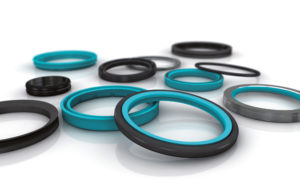
 Seals are simple objects, but obviously very critical to fluid power applications. Without a seal, there would be no way to contain one, two, three or four psi, let alone 4,000, 5,000, 6,000 to 10,000 psi or more that you tend to experience in fluid power applications—and that’s regardless of air, water, hydraulics, etc. They’re the unrewarded warrior of the fluid power industry, and they don’t get a lot of respect, but they sure deserve it.
Application is the component, the physical object that the seal is going to be installed into. Two of the most common ones are cylinders and pumps. What we want to talk about with application is where is the seal used, and in what type of component application. The most common type that you would consider for seals in fluid power applications are hydraulic cylinders.
Another application is pneumatic cylinder; they are a lot simpler, a lot lighter duty, but still just as important to seal. Otherwise you’d have just a big air blow gun. Hydraulic pumps, without the ability to seal, they wouldn’t be able to create fluid pressure.
Hydraulic valves also need sealing. Without sealing, they would hold no fluid. They’d just start leaking everywhere, and you could get no work done. Pneumatic valves, as well, all these objects contain seals. Why does application matter? An any of these particular examples, why is it important to consider what types of seals you’re going to use? Why cannot fluid power seals share the same technology? For example, you have a pneumatic cylinder has the same seals as a hydraulic one.
A large excavator is an example of hydraulics in extreme applications. They run high pressure systems, typically 4,000 psi or more, very heavy duty as well as high duty cycle, which means they can run for hours at a time, continuously, take a real beating, take a lot of abuse. Cylinders have to be very robust. You can imagine a $400,000 machine like this that is being rented on site, or is being used in construction of billion dollar buildings cannot have a lot of down time if you want to be productive. They use these modular welded-slash-mill-type cylinders. Typically, they’re made for the application, very high duty, very heavy duty. They typically can handle very high pressure. What’s important about this in application for an excavator, for example.
Let’s consider a light duty cylinder— not the type of cylinder you would want to use in an excavator.
Here you have a fairly narrow piston with a rod extending out, and on that rod is a weight. When you weight a cylinder in this fashion, called the side load, where you’re not having any force vector linear with the cylinder itself, but actually to the side of it, it wants to kind of cock inside the cylinder. It wants to come at an angle, and what that does is create wear inside the cylinder on the piston, in the barrel, and as well as the bearing and the gland on the head itself. The head of a cylinder is the side that the rod protrudes through. The cap of the cylinder is always the opposite side of that, so the piston side they would call it, of a cylinder. If you were to try to cycle the cylinder back and forth with the side load on it, it would start to wear on opposite sides of the barrel and piston, as well as start to wear the bearing and the gland.
The seals would wear, you would have scoring and scratching inside the barrel, and slowly the cylinder would lose effectiveness, if not have catastrophic failure of the rod itself. From a sealing perspective, with the high force loads, and the type of movements that excavators can go through, typically they’re made for digging. If you’ve ever seen say an excavator doing demolition they can push, pull, they can move things sideways. Some can crawl up into a dump truck all by themselves. They can also be abused and used in ways that they were not intended, so they really need to be heavy duty. Application specific, if we can make that heavy duty.
On a high-load piston, you may have four strips—a series of wear strips and guide rings. In the middle is a loaded-type O-ring; that’s your seal. It’s bidirectional, it seals from both directions. It takes very high pressure, although it does have a little bit of a high friction type situation going on. It’s very effective, and very good for leakage. By very good I mean they resist the leakage.
What you have is two wear strips, and those are on the outer sides of the piston, and a couple of guide rings. The wear strips tend to be a friction absorbing surface. You cannot really have a material close in properties to the barrel, the barrel being the green part. If you had, for example, wear rings that are made out of the same alloy of steel as the barrel is, and you try to slide those across from each other, that creates a lot of friction. They kind of want to stick, or almost melt together, in a way. It wouldn’t really melt because it’s not moving fast enough, there’s not quite enough friction. What you do is you add a wear strip there. That could be Teflon, or it could be glass impregnated fibers of some sort. They also support the load. This piston is very well-supported. It’s going to be very hard to put an angle on this piston, to cock it in the barrel. It wants to stay perpendicular with the barrel because of the amount of wear strips and guide rings that are keeping it centered.
Pistons, in this case, for an excavator, would have a very high load piston application, but as well you will see on the gland side. The gland is the part that’s on the rod that supports the seals and the bearings of the rod itself. I wouldn’t call it complicated, but this is a heavy-duty gland application. You can see that it also has a very large wear strip. On the rod itself, to the right side of the rod, that very long strip, that’s a bearing, and that’s also a support for the rod. If you imagine the combination of this very wide piston, which has a lot of surface area to rub against that barrel with, and the wear strip that’s on the gland of this piston, so that bearing support, it’s very well supported. It’s very hard to use side load to damage this cylinder. It can handle a lot of side load. It’s still not ideal. This particular cylinder has spherical rod eyes which allow it to stay aligned in misalignment type applications, but like I said side load is never ideal, but this thing is very resistant to it. It would take a lot to do damage to this particular cylinder.
With a flight simulator, there are six cylinders. There’s no rigging or fixturing other than being held up in free air with cylinders. They look like little twigs under a big flight simulator, but trust me the nature of fluid power means these things can hold a lot of mass. This is a very expensive heavy-duty application cylinder. It’s heavy duty in the sense that they’re high performance. Each of the six cylinders attach to three pivot points on both the floor and the simulator itself, but if at the bottom of each of those cylinders there’s those large kind of blocks. Rather than having it capped, there’s this big valve block assembly. Attached to that valve block is server valves. Those server valves are very responsive, a rapidly shifting valve that can be very precise in both motion and speed changes.
The previous cylinder on the excavator used like a T seal, so it’s very good at holding static loads, and it’s very good at resisting leakage through the piston. This application would be different because you want to be able to move dynamically very quickly. What it would have, it would be two unidirectional lip seals. Lip seals are different from a T seal, or a single O-ring with backups, in that they’re only able to resist pressure from one direction. Rather than one loaded T seal, you have two directional lip seals. The T seal is bidirectional, meaning that it can support pressure in either direction, whereas the directional lip seal, the example where I have the arrow, that one can only support pressure coming from the cap side, or the left side. If there was only one of those seals, and you tried to put pressure on it from the right side, it would just blow right by it. It would fold up that lip, meaning it would pass right through.
One of the advantages of a lip seal is that the U-shape itself, the more you energize pressure into it, the more that fluid is able to seal. Going from an extreme lip seal application, number one, you can see because of in this case it’s like a backwards C, but vertically up and down fluid will push on those grooves, and higher the pressure, the better the lip seal application will seal. It just will push harder and harder, but still it has great low-pressure breakaway. For that flight simulator application, it’s very quickly starting to move and stopping from moving because of the friction nature of it.
Lip seals are low friction, low wear, and low seal ability, especially at low pressure. The squeeze seals, or the interference type seals are high friction, high wear, and high seal ability. They’re the best for static applications. If you have something like a lift, or an object that is meant to hold loads in midair, that’s the best way to go.
Other applications, the seals you would choose for a pump are going to be different from what you see in a cylinder. This type of application just has a shaft seal and some static O-rings that seal the gears inside the housing. Because of the nature of a pump, pumps can also work at low pressure and high pressure. This is a U-cup shaft seal. This is pretty typical of what you see on one of those gear pumps.
Just getting a little bit closer into this, this one has this energized U-cup shaft seal, so that metal spring you see around the ID centered lip on this U-cup, there’s a spring that’s attached to that, and it’s always pulling it in. It’s energized on the shaft side of it so that when you install it there’s always a bit of pressure. Those that are loaded seals that we saw, they use the rubber itself. The rubber is bigger than the space it’s trying to take up. This one is a true U-cup, so the U shape is there. You could take that spring out, just pop it out, and it would still work as a U-cup, it would still seal at high pressure, but this spring allows it to seal at low pressure as well. It turns your pump into a general wide application type thing. The U-type seal makes it seal well at high pressure, but the energizer helps it seal well at low pressure.
A rotating union is something used in fluid power applications. It allows the rotor, which is up in the left side, to spin freely from the housing. For hydraulic applications, if you had a device like an arm that had to swing 360°, or did it in succession, or just need it to swivel back and forth, this allows you to have a union or a swivel joint that works very well in high speeds, and still seals.
The surface is very prone to damage from contamination and such, or you imagine if you try to force those together with too much pressure, if this is a mechanical seal in hydraulic application, all of that pressure, as pressure increases, you increase the force on the seal. With the balanced mechanical seal, because of the little arm that sticks down on the opposing side of that mechanical seal, pressure reaches both sides of the seal so that forces are equal and opposite, so that there’s never any pressurization from one side only. The pressure is balanced, so it’s always got the proper amount of wear, and it’s also got the proper amount of loading.
So where does the sealing take place? That’s critical to know. Is it taking place on a rod or a shaft, or is it somewhere static? Is it taking place on an outdoor application or indoor, those are considerations as well. Is it on machinery that’s mobile, or is it something industrial? Are you trying to keep fluid inside the component, or trying to keep the contamination out? For example, you have rod wipers on hydraulic cylinders that are good at keeping contamination out, but they’re definitely not a rod seal, they will not keep fluid inside the cylinder. As well, is it a static application or dynamic application? Static means it’s a seal that just sits there, takes pressure, but stops it from going through a crevice or gap, where dynamic applications are rod and shaft seals that either are rotating or sliding shafts, for example.

Leave a Reply