In our recent story, “Basics of static sealing,” Thomas Braun and Christoph Meissner with the Prädifa Technology Div. of Parker Hannifin’s Engineered Materials Group discussed the fundamentals of O-rings and back-up rings. And while rubber O-rings are probably the most common type of static seal, they indicated there are numerous other options design engineers should also consider.
 Extruded and cut seal profiles. One alternative to O-rings are extruded and cut seal profiles. In some sealing applications twisting of O-rings can cause problems, said Meissner. This may stem from improper assembly or due to pressure effects and minor relative movements in the sealing area. Partial twisting may lead to a short-term reduction of the material’s cross section and potential leaks. In the long run the seal itself may be damaged and completely fail.
Special profiles with an angular cross section at the bottom of the groove help avoid such problems, he explained. This effectively prevents twisting of the seal during assembly or in use. Due to the solid cross section, extrusion resistance against high pressures is also somewhat higher than that of O-rings. However, the design should be carefully calculated by experts to avoid leakage and damage, for instance by excessive filling of the groove.
Such seals are suited for a range of applications, including axial flange seals and radially acting static seals. Typical pressure range is to 200 bar and temperatures from -40° to 200° C. They are easy to install, may fit standard O-ring grooves, and come in various materials, said Meissner.
Rubber substitutes. O-rings are often made of rubber elastomers. But they also come in thermoplastic polyurethanes and take advantage of superior mechanical strength characteristics. They are often used whenever special robustness is required, said Braun. “Such O-rings are suitable for loading with far higher system pressure. Depending on the product design, TPU O-rings can be installed in grooves for classic O-rings, according to their cross section. As a result pressures up to 600 bar can be managed. Additional back-up O-rings can be omitted in this case so that groove dimensions can be minimized.”
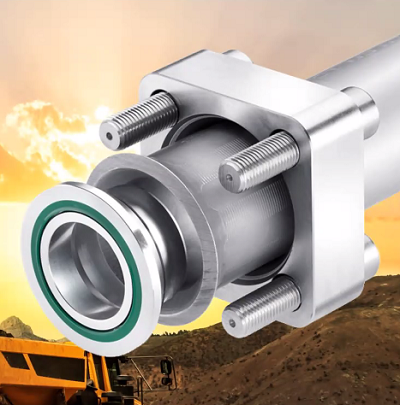
Polyurethane O-rings exhibit excellent compression set and high wear resistance. They are insensitive to pressure peaks, offer high extrusion resistance, and have high abrasive-wear resistance against pressure-induced micro-motion. Various TPU materials are available which differ in terms of media resistance and permissible temperature range to successfully cover most application profiles.
Flange seals. Flange connections such as Parker’s OV Series provide axial sealing against front faces. “In this case, system pressure applied to the inner diameter of the flange seal activates the sealing element, in addition to the initial preloading after assembly. The non-pressurized side of the sealing element supports itself against the groove length in the radial direction,” said Braun.
The design of the seal’s cross section and corresponding grooves ensures ease of assembly, eliminates the risk of twisting and offers high extrusion resistance. “Due to the preloading towards the groove’s flank even overhead installations are easy to perform. For applications that may have to withstand vacuums at the end diameter, a groove that is closed towards the inside is recommended,” he said.
While classic flange seals are made of rubber elastomers, TPU materials with their specific advantages can manage pressure peaks up to 600 bar. “Special TPU materials enable uses with non-polar pressure fluids such as mineral oils as well as with biodegradable fluids. TPU materials for use with extremely low temperatures are available as well,” said Braun.
Static radial seal. Hydraulic actuators typically have a head seal between the cylinder cap and tube. This static sealing element has a radial sealing effect and, due to its elastic properties, can even compensate for potential flexing of the cylinder under system pressure. Conventional sealing configurations used to feature an O-ring/back-up ring. Today, however, a single head seal typically takes the place of this arrangement, said Braun.
Parker developed the HS seal profile as a viable alternative to O-ring/back-up ring combinations for static seal applications at pressures to 600 bar. The robust symmetrical seal geometry and extrusion-resistant polyurethane compounds simplify installation and enhance sealing in pulsation pressure conditions.
Compared to conventional set-ups, the HS offers easier installation, no twisting, and much higher extrusion resistance. It is suitable for standard O-ring grooves with back-up rings. In addition to use in hydraulic cylinders, they are found in hydraulic valves, machine tools and injection molding machines, and in other radial, static applications operating at high pressures.
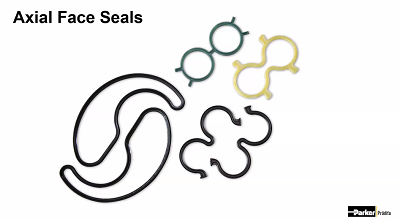
Axial face seals. Axial face seals are customer-specific molded shape seals for hydraulic pumps and motors. “Accordingly, there’s a wide variety of variants available in the market place,” said Meissner. “The seals are produced from rubber such as NBR, HNBR or FKM and typically complemented by a back-up ring made from reinforced plastic.
“However, there are also polyurethane variants that do not require a back-up ring, which may provide many advantages for pump and motor assembly. Special high-grade polyurethane materials not only meet the demand for long life at high pressures up to 250 or even 300 bar, but also deliver the corresponding temperature resistance and wide chemical resistance.” And they’re molded with high precision to match tight manufacturing tolerances. As a result they support simplifications in design, logistics and assembly up to and including fully automated processes.
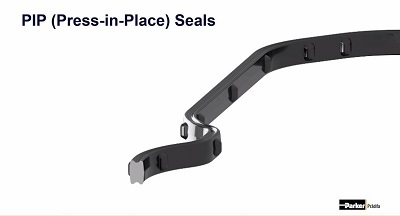
Press-in-place seals. These static axial seals handle intricate and challenging groove geometries. “Press-in place, ‘PIP’ seals, are particularly well suited for complex flange sealing requirements,” said Braun, because the seal cross section can be adapted to the application and available groove: narrow and deep as well as broad and shallow groove geometries are possible.
“These customized flange seals are often used when standardized O-rings or X-rings are not achievable, due to the requirements relating to the height-width ratio of the groove,” he said. And no expansion is required during assembly. “Most PIP seals features small beads on the circumference of the seal geometry. These beads will then retain the sealing element in the groove and, thus, also enable overhead installation.”
Designs come in shapes ranging from circular versions to variants featuring multiple loops, and multiple seals such as screw seals and secondary seals may be integrated in one component — enabling several fluid channels to be sealed with one element.
When installing large PIP seals attention must be paid to uniform stress distribution in the circumferential direction, added Braun. In this case the installation is performed consecutively from several points of the circumference. They’re available in a wide range of rubber elastomers, silicones, and thermoplastic elastomers.
Composite sealing plates. Composite sealing plates — Parker terms them Gask-O-Seals — are among the most complex static sealing elements, said Braun. Their functional principle corresponds to that of an axial face seal and allows for highly customized designs. Unlike sealing elements using pure elastomer materials, the composite sealing elements have a rigid carrier element of metal or hard plastic. The elastomer element attaches to the carrier element by chemical bonding, by a positive locking connection, or both. This makes it possible to seal several flange areas with a single sealing element, as well as separate various media — such as oils, coolants, fuels and gases.
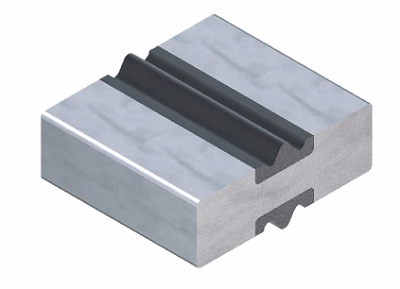
They are designed with specific elastomer profiles integrated in or on the sealing plate. Among the advantages, the seal and groove are engineered as a single element, no seal groove is required on the flange, and compression of the sealing lip is precisely defined.
After installation, the sealing lip is protected from external influences and from internal, mechanical overloading. They offer easy and straightforward assembly and high operating reliability. And because the sealing plate is visible from the outside, it can be readily checked.
Gask-O-Seals composite sealing elements are particularly suited for difficult assembly scenarios. For example, a single rigid and easy-to-handle component may be used for sealing several areas in underwater, oil and gas assembly applications. Composite sealing plates are available in various versions, depending on the specific elastomeric element and carrier component. They are recommended for use as quasi-static sealing elements in flange areas, with pressure capability to about 60 bar and temperatures typically from -50° to 200° C.
Parker Hannifin
www.parker.com